


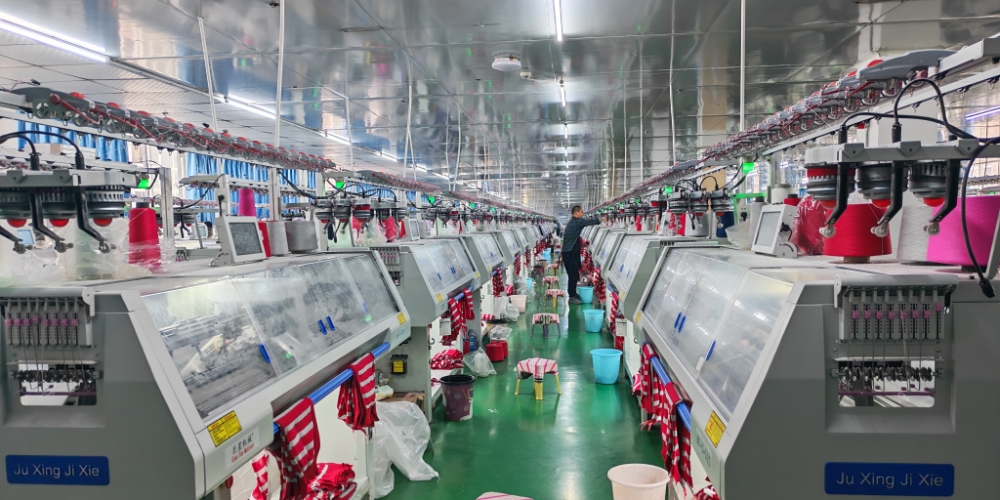
Quick answer: Before a single stitch is knitted, a sweater factory must complete four yarn-preparation gates: yarn lot selection from a qualified spinner, count and twist verification, colour matching against an approved standard, and relaxation / conditioning so the yarn reaches the humidity and tension the knitting programme assumes. Skipping any gate shows up later as barry lines, shade variation between panels, or a garment that shrinks out of tolerance after the first wash. At Shaanxi Qirui Textile, yarn preparation is a documented stage with recorded lot numbers, not an informal step.
In this article
- Why yarn preparation decides the final garment
- The four yarn-preparation gates
- Fibre selection: cashmere, wool, and blends
- Yarn count, ply, and twist
- Colour approval and lab-dip discipline
- Relaxation, conditioning, and moisture regain
- Pre-knitting inspection checklist
- What goes wrong when yarn preparation is rushed
- What buyers should ask a knitwear supplier
- Frequently asked questions
Why yarn preparation decides the final garment
A knitted sweater is a single continuous structure. Unlike woven fabric, where a defect can be cut away and the panel replaced, a knitting fault runs through the whole piece. That is why knitwear quality is largely determined before the machines start.
Three properties of the incoming yarn propagate directly into the finished garment:
- Dimensional stability. Yarn that has not been relaxed will continue to shrink after knitting, so the wash-test dimensions drift from the approved size chart.
- Surface consistency. Variations in count or twist between lots knit into visible horizontal bands, known in the trade as barry lines or barré.
- Shade consistency. Panels knitted from different dye lots read as different tones under retail lighting, even when the colour number matches.
All three are preventable at the yarn store, and all three are expensive to correct after knitting.
The four yarn-preparation gates
A disciplined factory treats yarn preparation as a sequence of gates, each with a documented pass condition. The table below is the sequence used at Qirui Textile.
| Gate | Objective | Evidence recorded | Pass condition |
|---|---|---|---|
| 1. Lot selection | Match the customer brief to a qualified spinner and yarn lot | Spinner name, lot number, fibre composition certificate | Composition within ±0.5% of the approved spec |
| 2. Count & twist check | Confirm the yarn knits at the programmed gauge | Measured count (Nm or tex), twist per metre | Count within tolerance of the tech-pack; twist consistent lot-to-lot |
| 3. Colour approval | Lock the shade before bulk dyeing | Lab dip signed by buyer, spectrophotometer reading | Delta-E within the agreed tolerance under the agreed light source |
| 4. Relaxation & conditioning | Bring yarn to the tension and moisture the programme assumes | Storage duration, ambient temperature and relative humidity | Yarn cones rested for the specified period; regain in target band |
Fibre selection: cashmere, wool, and blends
The fibre decision drives price, hand-feel, and care instructions, so it is normally settled with the buyer before yarn preparation begins. The comparison below covers the fibres currently used across the Qirui product range.
| Fibre | Typical micron range | Hand-feel | Best suited to | Care considerations |
|---|---|---|---|---|
| Cashmere (goat undercoat) | 15–19 micron | Extremely soft, light, high warmth-to-weight | Premium knitwear, luxury retail, gifting | Hand wash or gentle cycle; dry flat; pilling risk in first wears |
| Fine wool / merino | 18–24 micron | Soft with more resilience than cashmere | Everyday sweaters, school and workwear | Machine washable if treated; holds shape well |
| Goat wool | Roughly 25–30 micron | Denser, more structured | Thick knit sweaters, textured cable patterns | Durable; less soft against the skin |
| Mohair blend | 25–35 micron (blended) | Halo finish, fluffy, lightweight | Fashion statement pieces, brushed looks | Sheds fibres initially; needs careful finishing |
| Alpaca blend | 20–26 micron | Smooth, drapey, thermally efficient | Oversized and brushed pullovers | Heavier drape; supports relaxed silhouettes |
Blends are common because they let a buyer tune cost against performance. A 70/30 cashmere-wool blend, for example, keeps much of the softness while improving tensile strength and reducing cost per garment.
Yarn count, ply, and twist
Count describes yarn thickness; ply describes how many strands are twisted together; twist describes how tightly. These three numbers determine how the yarn behaves on a flat knitting machine.
| Parameter | What it controls | If it is wrong |
|---|---|---|
| Yarn count | Gauge compatibility and fabric density | Too thick: machine strain, dropped stitches. Too thin: loose, unstable fabric |
| Ply | Strength, uniformity, and surface evenness | Single-ply yarns show more irregularity; too many plies reduce drape |
| Twist direction and level | Stitch definition, fabric hand, and pilling tendency | Low twist pills faster; excessive twist makes the fabric harsh and can skew panels |
| Yarn evenness | Absence of thick/thin places | Uneven yarn knits into visible barré lines across the body |
For heavier garments, weight per piece becomes a useful verification number. In the current Qirui range, a men's heavy cable-knit crew neck is specified at 390–460 g, a men's lapel cardigan at 530–560 g, and a women's cropped turtleneck at 220–225 g. Weighing finished garments against these bands is a fast, low-cost check that the yarn count actually delivered matches the yarn count specified.
Colour approval and lab-dip discipline
Colour problems are the most common source of buyer-supplier dispute in knitwear, and almost all of them trace back to an incomplete approval step. A workable colour protocol has three parts:
- Lab dip against an agreed standard. The buyer approves a physical dip, not a screen rendering, and the approval is dated and signed.
- Specified light source. The same colour reads differently under D65 daylight and under store tungsten. Tolerance must be agreed under a named illuminant.
- Delta-E tolerance in writing. A numeric limit replaces subjective judgement and gives both sides a pass/fail test.
Where a buyer supplies a reference swatch rather than a Pantone number, the factory should return the closest achievable dip with an honest delta reading rather than claiming an exact match.
Relaxation, conditioning, and moisture regain
Natural fibres absorb moisture from the air. Cashmere and wool reach equilibrium with ambient humidity, which means the same yarn can knit to slightly different dimensions on a dry winter day than in a humid summer one.
Two practices control for this:
- Resting the cones. Yarn is allowed to stand after winding so internal tension equalises before it is fed to the machine.
- Conditioning the knitting floor. Temperature and relative humidity are held in a stable band, and the same band is used for the pre-production sample and bulk.
This is why a factory that samples in a controlled room and then bulk-produces in an uncontrolled one will pass the sample and fail the shipment, even though nothing changed in the design.
Pre-knitting inspection checklist
Before a lot is released to the knitting floor, the following should be signed off. This is the checklist format Qirui Textile applies to bulk orders.
| Check | Method | Recorded against |
|---|---|---|
| Fibre composition | Certificate review plus incoming fibre test | Yarn lot number |
| Yarn count | Measured against tech-pack value | Yarn lot number |
| Twist level and direction | Measured against approved sample | Yarn lot number |
| Colour | Spectrophotometer reading versus approved dip | Dye lot number |
| Evenness | Visual inspection on a yarn board | Yarn lot number |
| Moisture regain | Conditioned weight measurement | Yarn lot number |
| Knitting trial | Sample panel knitted and measured | Machine number and programme |
| Wash test on trial panel | Dimensional change measured after washing | Trial panel reference |
What goes wrong when yarn preparation is rushed
The failures below are the reason this stage exists. Each has a specific, recognisable symptom on the finished garment.
| Rushed step | Symptom in the finished garment | Cost of correction |
|---|---|---|
| No lot segregation | Shade variation between panels and between sizes in the same order | Re-knit affected panels; possible full-order rejection |
| Count not verified | Weight per garment outside the specified band; wrong thickness | Re-spec or re-knit |
| No lab dip approval | Colour drift from the buyer standard | Re-dye yarn and re-knit |
| Yarn not relaxed | Shrinkage after first wash; garment falls outside size tolerance | Re-knit with corrected programme |
| No moisture control | Sample passes, bulk drifts; inconsistent hand-feel between batches | Reprocess or re-knit |
The pattern is consistent: the cost of correction is orders of magnitude larger than the cost of the check. A yarn count measurement takes minutes; re-knitting a bulk order takes weeks.
What buyers should ask a knitwear supplier
When evaluating a knitwear manufacturer, these questions distinguish a factory that has a yarn-preparation system from one that simply orders yarn and starts knitting:
- Can you show yarn lot numbers and fibre composition certificates for a recent order?
- Do you approve colour by physical lab dip, and under which light source is tolerance measured?
- What is your numeric delta-E tolerance, and is it written into the order confirmation?
- Is the knitting floor humidity-controlled, and is the same environment used for sampling and bulk?
- What is your weight tolerance per garment, and do you weigh every piece or sample it?
- What happens to a yarn lot that fails incoming inspection?
A supplier that answers these with specific numbers and documents is a lower-risk partner than one that answers with assurances.
Frequently asked questions
Does yarn preparation differ between cashmere and wool?
The gates are the same, but the tolerances tighten for cashmere. Cashmere fibres are finer and more sensitive to mechanical stress, so relaxation times are longer and handling is gentler. Cashmere also shows shade variation more readily, which makes lot segregation stricter.
Why do two sweaters in the same order sometimes look slightly different in colour?
Almost always a dye-lot issue. If yarn from two dye lots is knitted into one order without segregation, the difference becomes visible. The fix is to require a single dye lot per colour per shipment, or to approve the split in advance.
How long should yarn rest before knitting?
It depends on fibre, count, and how the yarn was wound. The practical answer is that resting continues until the yarn measures consistently against the tech-pack count and twist, and until the pre-production panel washes within dimensional tolerance. Fixed hour counts without a measurement are a weak control.
Can a buyer specify yarn count directly?
Yes, and it is good practice. Buyers who specify fibre composition, count, ply, twist, and weight per garment give the factory an unambiguous target, which makes first-sample approval faster and bulk disputes far less likely.
Does yarn preparation cost the buyer anything?
It is built into the unit price, but it is far cheaper than the alternative. Yarn verification, lab dips, and conditioning add a small amount of lead time at the front of the order. Re-knitting a rejected shipment adds weeks and often the whole margin.
Related reading
- Gauge, stitch structure and inline QC: how knitwear quality is controlled on the machine
- Knitwear size grading, fit and finishing: turning an approved sample into a size run
Planning a wool or cashmere knitwear order?
Send us your tech-pack, fibre specification, and target quantity. We will confirm yarn options, sampling lead time, and the MOQ that fits your programme.
Continue reading
For the next stage in the process, see how knitting programmes and gauge selection determine the fabric hand and shape of the finished sweater.